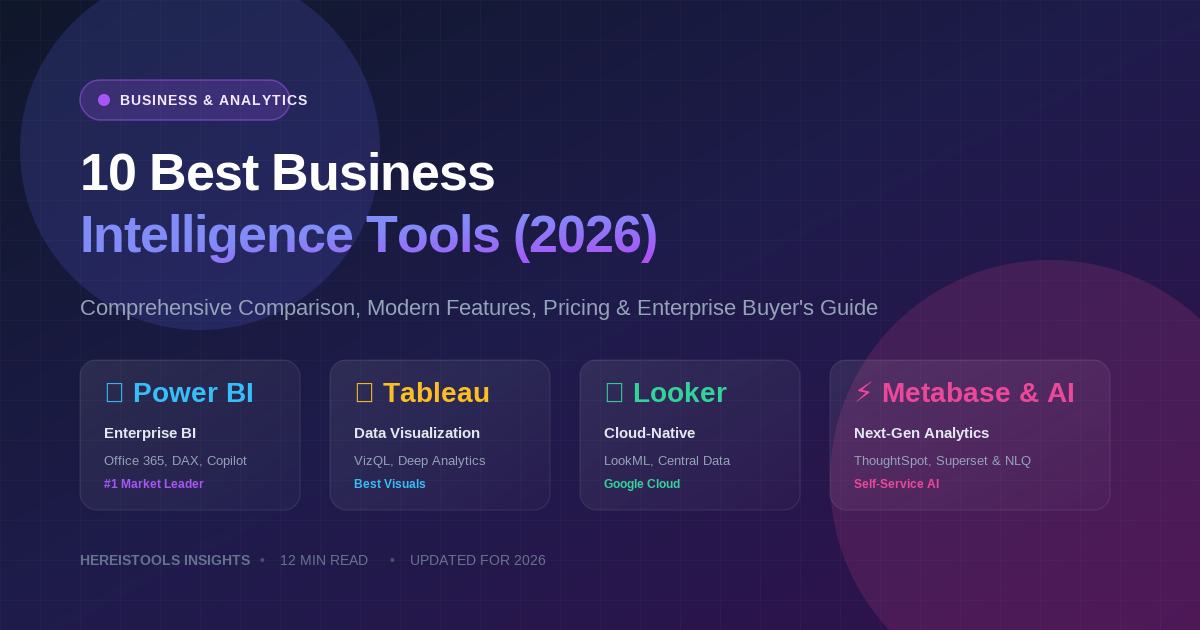
Executive Overview: Making data-driven decisions is the difference between thriving and falling behind in today's digital economy. At World Web Tools, we evaluated the leading business intelligence (BI) suites to help analysts, product managers, and founders choose the perfect platform. From enterprise analytics giants like Microsoft Power BI and Tableau to modern agile alternatives like Looker and open-source engines, here is your definitive 2026 guide.
What Are Modern Business Intelligence Tools?
Business intelligence tools are integrated software platforms designed to gather, clean, transform, and analyze business data across disparate corporate databases, cloud warehouses, and marketing APIs. Instead of maintaining fragile static spreadsheets, modern BI solutions empower teams to monitor operational KPIs, generate predictive forecasts, and visualize complex trends through real-time dashboards.
In 2026, the global analytics benchmark is driven by natural language questioning (NLQ) and embedded machine learning. Today's knowledge workers can simply ask questions in plain English—such as "Which regional campaigns delivered the highest customer lifetime value last quarter?"—and instantly receive automated charts, correlation breakdowns, and executive summaries.
Strategic Insight: The ultimate goal of modern business intelligence is democratization. High-performing companies eliminate data bottlenecks by providing self-service visual reporting across marketing, finance, engineering, and logistics teams.
Key Evaluation Criteria for Choosing a BI Platform
When assessing the top business intelligence tools, our research focused on five core pillars:
- Universal Data Connectors: Direct connections to modern cloud warehouses including Snowflake, Google BigQuery, Databricks, PostgreSQL, and popular SaaS endpoints without requiring third-party connectors.
- Visualization Depth & Customization: Diverse charting capabilities, geospatial maps, interactive drill-downs, and mobile-ready layouts.
- AI-Assisted Analysis: Native AI assistants that automate complex SQL queries, summarize anomalies, and draft executive briefings.
- Data Governance & Security: Enterprise-grade role-based access control (RBAC), row-level security (RLS), SOC 2 compliance, and audit logging.
- Pricing Predictability: Transparent licensing tiers between dashboard creators and business viewers to prevent unexpected enterprise budget creep.
The Top 10 Business Intelligence Tools in 2026
1. Microsoft Power BI — Unbeatable Enterprise Value & Office 365 Sync
Microsoft Power BI remains the global market leader in enterprise reporting. Combining the intuitive data-modeling capabilities of Power Query with the analytical horsepower of DAX (Data Analysis Expressions), Power BI delivers world-class data modeling seamlessly connected to Excel, Microsoft Teams, and Azure.
- Best For: Organizations running Microsoft 365 and Azure environments seeking enterprise analytics at an affordable entry cost.
- Key Advantages: Unrivaled Office 365 collaboration; native Microsoft Copilot integration; rich community visual library; desktop authoring client.
- Pricing: Free Desktop version; Pro licenses start at $10/user/month; Premium per user at $20/month.
2. Tableau (Salesforce) — The Gold Standard for Visual Exploration
Renowned for its patented VizQL engine, Tableau transforms drag-and-drop actions into expressive graphic queries. It provides unmatched visual storytelling capabilities for data scientists and dedicated analysts who need to spot subtle correlations within massive multi-dimensional datasets.
- Best For: Professional data analysts, enterprise business researchers, and teams requiring publication-grade visual reporting.
- Key Advantages: Exceptional visualization versatility; vibrant Tableau Public community; deep native Salesforce CRM integrations.
- Pricing: Creator tier at $75/user/month; Explorer at $42/user/month; Viewer at $15/user/month.
3. Looker (Google Cloud) — Centralized Semantic Governance
Operating entirely within your cloud data warehouse, Looker replaces fragmented desktop data silos with LookML, its centralized, git-versioned modeling layer. This ensures that every department works from identical metrics, eliminating conflicting business calculations.
- Best For: Engineering-first teams utilizing Google BigQuery, Snowflake, or AWS Redshift who demand unified metric governance.
- Key Advantages: Version-controlled data modeling; in-database processing guarantees real-time freshness; Google Cloud Gemini AI features.
- Pricing: Tailored enterprise platform licensing based on cloud instances and concurrent user seats.
4. Qlik Sense — Associative Engine for Non-Linear Discovery
Unlike standard SQL tools that restrict queries to predefined relational paths, Qlik Sense is powered by an in-memory Associative Engine. As users interact with values, Qlik highlights related records in white and unrelated records in grey, instantly uncovering hidden blind spots.
- Best For: Supply chain planners, financial fraud analysts, and operational managers who need multi-directional data exploration.
- Key Advantages: Fast in-memory associative indexing; automated intelligent alerting; hybrid cloud/on-premise deployment options.
- Pricing: Standard subscriptions starting around $30/user/month with custom enterprise quotes.
5. Domo — Real-Time Cloud Operating System & Mobile Dashboards
Domo integrates data ingestion, ETL (Magic ETL), dashboard design, and team collaboration into a unified cloud interface. Its mobile application provides real-time operational notifications and KPI tracking for executives on the move.
- Best For: C-suite leaders and rapidly growing companies requiring zero-maintenance turnkey cloud reporting.
- Key Advantages: Over 1,000 pre-built connectors; intuitive no-code Magic ETL pipeline builder; industry-leading mobile UX.
- Pricing: Freemium starter tier followed by consumption-based pricing models.
6. Sisense — Best for Embedded Product Analytics
If your roadmap involves embedding interactive data dashboards directly inside your own SaaS software, Sisense is the industry standard. Its API-first design and white-labeling capabilities allow engineering teams to ship customer-facing analytics with ease.
- Best For: B2B SaaS companies, client portals, and software development agencies.
- Key Advantages: Comprehensive REST APIs and JavaScript SDKs; custom white-label branding; composite in-chip data engine.
- Pricing: Custom annual licensing based on product scale and embedded user volume.
7. Zoho Analytics — Best Budget-Friendly BI for Startups & SMBs
For growing small businesses and ecommerce brands that need powerful analytics without enterprise overhead, Zoho Analytics offers exceptional value. It features Zia (an AI conversation assistant) and automated sync with Google Ads, Shopify, Stripe, and QuickBooks.
- Best For: SMBs, bootstrapped startups, and digital marketing agencies.
- Key Advantages: Highly affordable entry plans; pre-configured industry dashboard templates; seamless sync with the Zoho ecosystem.
- Pricing: Free tier for 2 users; paid plans start at $24/month for 2 users.
8. Metabase — Modern Lightweight Open-Source BI
Metabase is the go-to tool for modern tech startups. Setting up in minutes via Docker, it empowers non-technical teammates to build charts through a visual query builder while giving senior developers a powerful SQL editor with dynamic variables.
- Best For: Tech startups, engineering teams, and product managers who value simplicity and open-source transparency.
- Key Advantages: Intuitive question builder; lightweight resource footprint; free self-hosted open-source edition (AGPL).
- Pricing: 100% Free Open Source self-hosted; Cloud/Pro tiers start at $85/month.
9. ThoughtSpot — Search-Driven Analytics Powered by Generative AI
ThoughtSpot rethinks analytics by replacing static dashboards with a search bar. Users type natural language questions and ThoughtSpot's generative AI engine generates interactive charts and anomaly insights on demand.
- Best For: Large organizations seeking to eliminate repetitive dashboard requests and empower non-technical staff.
- Key Advantages: Search-first analytics interface; automated anomaly detection (SpotIQ); eliminates dashboard maintenance fatigue.
- Pricing: Usage-based plans starting at $95/month for Team editions up to enterprise packages.
10. Apache Superset — Scalable Open-Source Big Data Analytics
Originating at Airbnb and maintained by the Apache Software Foundation, Apache Superset is a cloud-native, open-source BI platform capable of querying petabyte-scale data engines like Trino, ClickHouse, Presto, and Druid with zero software licensing costs.
- Best For: High-growth engineering teams and organizations running large-scale data stacks who avoid vendor lock-in.
- Key Advantages: 100% free open-source code; virtually unlimited scalability; extensive custom visualization plugin support.
- Pricing: 100% Free Open Source (self-hosted); managed cloud hosting available via Preset.io.
BI Platform Feature Comparison Matrix
| Platform | Primary Strengths | Learning Curve | Deployment | Starting Price |
|---|---|---|---|---|
| Microsoft Power BI | Enterprise Value & Office 365 | Moderate | Cloud SaaS & Desktop | $10 / user / mo |
| Tableau | Advanced Visual Storytelling | Steep | Cloud, Server, Desktop | $75 / user / mo |
| Looker | Centralized Semantic Modeling | Steep (Developers) | Google Cloud Native | Custom Quote |
| Qlik Sense | Associative Non-Linear Exploration | Moderate | Cloud & On-Premise | $30 / user / mo |
| Domo | Turnkey Cloud & Mobile Dashboards | Gentle | 100% Cloud SaaS | Consumption Tier |
| Sisense | Embedded SaaS Customer Analytics | Moderate (API-First) | Cloud & Hybrid | Custom Quote |
| Zoho Analytics | SMB Affordability & App Sync | Gentle | Cloud & On-Premise | $24 / mo (2 users) |
| Metabase | Lightweight & Fast Open Source | Very Gentle | Self-Hosted / Cloud | Free Open Source |
| ThoughtSpot | Search-Driven & Generative AI | Gentle (Search Bar) | Cloud SaaS | $95 / month |
| Apache Superset | Big Data Scalability & No Vendor Lock-in | Moderate to Steep | Self-Hosted Docker/K8s | 100% Free Open Source |
How to Choose the Right BI Software for Your Team
Selecting the right analytics software requires balancing technical architecture with user adoption:
- Match Your Tech Stack: If your team works in Excel and Azure, Power BI is the clear choice. If your data lives in Google BigQuery, Looker provides seamless native integration.
- Know Your End Users: For dedicated data scientists, Tableau and Superset offer the deepest analytical controls. For business managers, Metabase and Zoho Analytics allow quick self-service answers.
- Calculate Total ROI: Review total licensing, infrastructure costs, and analyst hours. Use our free ROI Calculator and Profit Margin Calculator on World Web Tools to model expected productivity gains against subscription costs.
- Verify Input Data Quality: Clean data pipelines are essential for accurate dashboards. Developers can use our JSON Validator and CSV to JSON Converter to test API payload integrity before database ingestion.
Frequently Asked Questions (FAQs)
What is the primary difference between Power BI and Tableau?
Power BI is more affordable ($10/user/month vs $75/user/month for Tableau Creator), integrates directly with Microsoft 365, and feels familiar to Excel users. Tableau offers superior visual flexibility, complex statistical charting capabilities, and remains the benchmark for dedicated visual analysts.
What are the top free or open-source BI tools?
Metabase is the most user-friendly open-source tool for startups and product teams, while Apache Superset is the leading open-source choice for big data engineering teams querying Snowflake, ClickHouse, or Presto with zero licensing fees.
Can small businesses gain real value from business intelligence tools?
Yes. Solutions like Zoho Analytics and Google Looker Studio allow small businesses and ecommerce sellers to connect their Google Ads, Facebook Ads, Shopify, and accounting systems into a single automated dashboard for clear daily visibility.
How does AI improve BI software in 2026?
AI enables natural language questioning, automated anomaly detection, automated narrative summaries, and predictive forecasting, empowering non-technical users to discover data insights without writing manual SQL queries.
Is company data secure when using cloud BI platforms?
Tier-one cloud BI vendors enforce rigorous security controls including SOC 2 Type II compliance, HIPAA readiness, AES-256 data encryption, and granular row-level security (RLS) to ensure team members only access information relevant to their role.